Port of Kribi: Performance Serving the Nation
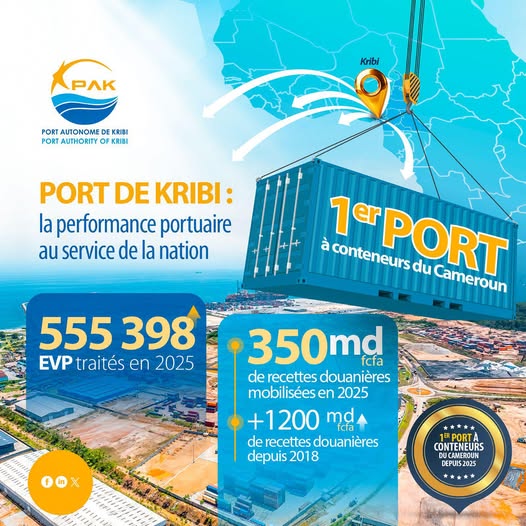
Port of Kribi: Performance Serving the Nation
Strong 2025 results confirm its key role in Cameroon’s economy
With over 555,000 TEUs handled and 350 billion FCFA in customs revenue generated in 2025, the Port Authority of Kribi stands as a major driver of Cameroon’s economic transformation.
👉 Read the full editorial and share your perspective: how do you assess the impact of the Port of Kribi on the national economy?
At a time when our country is consolidating its ambitions for emergence and economic sovereignty, the performance of strategic infrastructure is a decisive lever for national transformation. The port is not merely a point of entry and exit for goods; it is a catalyst for growth, an accelerator of investment, and a pillar of public resource mobilization. It is in this spirit that the Kribi Autonomous Port, which became Cameroon’s leading container port in 2025, is resolutely and methodically pursuing its mission in service of the Nation.
A Structuring Performance Momentum
The year 2025 marks a historic milestone in the rise of our port platform. By becoming the country’s leading container terminal and contributing to the mobilization of a record 350 billion CFA francs in customs revenue on-site, the Port of Kribi confirms the relevance of the strategic choices made in recent years.
These results are neither accidental nor circumstantial. They reflect a clear vision: to make Kribi a modern, competitive, and high-performing logistics hub capable of meeting the demands of international trade and the expectations of national and sub-regional economic operators.
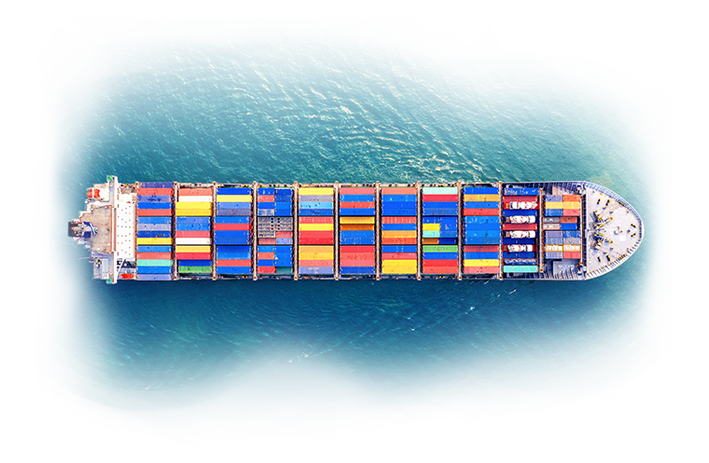
In 2025, the port handled 555,398 twenty-foot equivalent units (TEUs), representing 37.5% of national container traffic, and a total tonnage of 12.7 million tonnes, an increase of 19% compared to 2024. Total port revenue reached 35.3 billion CFA francs, with net profit exceeding 3.4 billion CFA francs. Since the start of its operations in 2018, the Port of Kribi has enabled the cumulative collection of more than 1,200 billion CFA francs in customs revenue, illustrating its structuring role for the national economy and the financing of public policies.
A Major Driver of Employment and Economic Development
Since its commissioning, the Port of Kribi has established itself as a powerful lever for job creation and socio-economic transformation. It has generated more than 5,000 direct jobs, mobilizing diverse skills in port trades, logistics, industry, engineering, maintenance, administrative services, and operations management.
In addition to these direct jobs, an equivalent number of indirect jobs—estimated at more than 5,000—has been created within the broader port ecosystem: road transporters, handling companies, shipping agents, freight forwarders, industrial subcontractors, service SMEs, technical providers, and actors in trade and catering.
Beyond these immediate effects, the port also drives a significant dynamic of induced employment linked to the growth of local economic activities, urban expansion in Kribi, and the development of essential services (housing, healthcare, commerce, education, and construction).
This performance confirms the role of the Port of Kribi as a true catalyst for youth employment, the expansion of economic opportunities, and the gradual structuring of a more competitive local entrepreneurial fabric.
Thus, the port is not limited to being a strategic logistics infrastructure; it stands out as an integrated economic development hub serving sustainable territorial transformation and national wealth creation.
Kribi Port Industrial Zone (KPIZ): A Driver of Wealth Creation
The Kribi Port Industrial Zone (KPIZ) is the strategic extension of the Port of Kribi and a major lever for Cameroon’s industrialization. It transforms port performance into direct value creation within the national territory.
With more than 4,000 hectares dedicated to industrial and logistics development, KPIZ is gradually attracting investment in processing industries, logistics, agro-industry, and construction materials, representing several hundred billion CFA francs in potential medium-term investments.
Beyond infrastructure, its impact is primarily human and social: KPIZ is expected to generate thousands of direct jobs, with a multiplier effect estimated at 3 to 5 indirect and induced jobs for each direct job, particularly in transport, subcontracting, services, and local SMEs.
It thus plays a decisive role in structuring an economic ecosystem around Kribi, enhancing the skills of the local workforce, and promoting youth employment.
KPIZ confirms the transformation of the Port of Kribi into a true integrated industrial hub, where logistics performance translates into national wealth creation.
A Port at the Heart of Public Resource Mobilization
Port performance is inseparable from fiscal performance. Every container handled, every secured operation, and every optimized procedure directly contributes to increasing public revenue and financing public policies.
The record achieved in 2025 illustrates the port’s structuring role in the national economic value chain and the quality of collaboration among the various administrations present on the platform, particularly customs services, as well as the commitment of port and logistics stakeholders.
By improving operational fluidity, strengthening digitalization, and enhancing procedural transparency, Kribi actively contributes to reducing revenue losses and optimizing state performance.
Modernity, Competitiveness, and Attractiveness
In an increasingly competitive maritime and logistics environment, performance cannot be sustainable without innovation. The Port of Kribi is firmly committed to continuous modernization: infrastructure adapted to large vessels, high-performance equipment, digitalized procedures, and international safety and security standards.
This modernity sends a strong signal to investors, shipowners, and economic operators. It enhances Cameroon’s attractiveness as a trading platform for the sub-region and as a credible destination for industrial and logistics investments.
Kribi is not just a high-performing port; it is a lever for industrialization, an anchor point for value chains, and a factor of regional integration. The Phase II expansion of the container terminal, completed in 2025, increases annual handling capacity to over 1 million TEUs, consolidating its strategic role for the country and the sub-region.
A Collective Performance
Behind the figures are men and women. The 2025 performance is above all that of a committed port community: staff of the Kribi Autonomous Port, institutional partners, private operators, handlers, shipping agents, transporters, and administrations.
I would like to commend their professionalism, their sense of the public interest, and their adaptability. The performance culture we promote is based on rigor, responsibility, and the constant pursuit of excellence. Making performance a collective source of pride ensures the port’s long-term trajectory of shared progress.
Serving the Nation, Preparing the Future
Port performance is not an end in itself. It is a means to a broader goal: contributing to national prosperity, strengthening economic sovereignty, and improving Cameroon’s competitiveness.
The results achieved in 2025 encourage us to go further. They also compel us to maintain high standards, strengthen governance, continue strategic investments, and anticipate shifts in global trade.
Kribi, Cameroon’s leading container port since 2025, will continue to fully assume its economic responsibility. Because a high-performing port means a stronger economy—and a stronger economy means a stronger Nation.
Patrice MELOM
Director General
Kribi Autonomous Port